
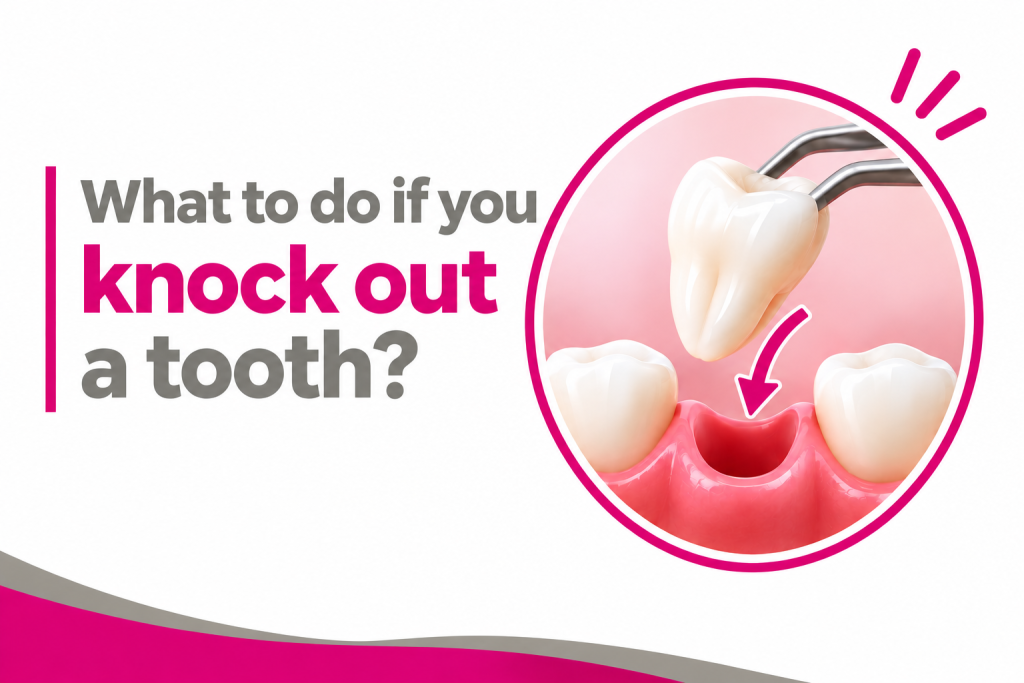
What to Do If You Knock Out a Tooth: Emergency Dental First Aid
Whether it happens during a weekend football match or an accidental knock at home, a knocked-out tooth (clinically known as an avulsed tooth) is one of the few true dental emergencies. Acting quickly, ideally within 30 minutes, gives the tooth the best chance of being saved.
Here is step-by-step first aid from our dentists that you can follow under pressure.
The short answer: Hold the tooth by the crown (the white part you see when smiling), never the root. If it is dirty, rinse it under cold running water for no more than 10 seconds. Put it back into the empty socket, then bite gently on a clean cloth to hold it in place. If you can’t, keep it in cold milk and see a dentist straight away. Don’t let it dry out or sit in water, and don’t try to put back a baby tooth.
When to go to hospital first
Go to your nearest hospital emergency department or call 000 if there is:
- A head injury, loss of consciousness, vomiting or confusion
- A suspected broken jaw
- Heavy bleeding that won’t stop with pressure
- A missing piece of tooth that may have been swallowed or breathed in
If the tooth is saved, bring it with you in milk.
The Critical First 60 Minutes: Immediate Steps for a Knocked-Out Adult Tooth
If an adult tooth has come completely out of its socket, stay calm and follow these steps.
- Find the tooth and hold it by the crown only. Pick it up by the crown, the white part you see when smiling. Do not touch the root (the yellowish part below the crown). The root is covered in fragile living cells that the tooth needs to reattach.
- Rinse briefly, only if it’s dirty. If the tooth has dirt or grass on it, rinse it gently in cold milk or saline, or hold it under cold running water for no more than 10 seconds. Do not scrub, scrape or use soap or alcohol.
- Try to put the tooth back in the socket. Turn the tooth so the front faces outwards, then slide it into the empty socket with light finger pressure. Bite gently on a clean tissue or folded cloth to hold it in place. If it doesn’t slide in easily, don’t force it.
- If you can’t put it back, keep it moist. Place it in a small container of cold milk, saline, or a tooth preservation kit (Hank’s Balanced Salt Solution). If none of these are available, adults can hold the tooth in their mouth between the cheek and gum. Never let the tooth dry out, and never store it in plain tap water.
| Storage option for an adult tooth | How suitable |
| Back in the socket | Best option |
| Cold milk | Excellent first choice |
| Tooth preservation kit (HBSS) | Excellent |
| Saliva (in a cup or held in the mouth by an adult) | Good |
| Saline | Acceptable for a short time |
| Plain water | Avoid |
| Tissue, napkin or pocket (dry) | Avoid |
- Get emergency dental treatment straight away. Call Smilexcellence Dental Care on 0424 966 544 right away. Even if the tooth went back in perfectly, a dentist still needs to check its position and stabilise it as soon as possible. Our opening hours are Monday to Friday 9:00am–6:00pm and Saturday 8:00am–2:00pm. Outside these hours, call the same number for our emergency triage line. If you can’t reach us, go to your nearest hospital emergency department. See our emergency dentist page for more information.
How Do You Treat a Knocked-Out Tooth in Children vs Adults?
The most important rule in dental first aid is knowing whether it’s a baby tooth or an adult tooth, because the advice is completely different.
| Baby (primary) tooth | Adult (permanent) tooth | |
| Typical age | Babies and children up to about 12. Front baby teeth usually fall out between 6 and 8. | Older children, teenagers and adults |
| Put it back in? | No. Never put a baby tooth back in. | Yes. Put it back, or keep it in milk. |
| Why | Putting it back can damage the adult tooth growing underneath. | Keeping the natural tooth helps preserve the bone and the position of nearby teeth. |
| What to do | Control bleeding with gauze, then see a dentist to check for broken pieces and damage to the adult tooth underneath. | Follow the first aid steps above and get urgent dental treatment. |
Not sure if it’s a baby or adult tooth? Don’t put it back. Keep it in milk and call us straight away.
Can You Still Save a Knocked-Out Tooth That Has Dried Out?
It depends on how long it has been dry.
| Time the tooth has been dry | What it means |
| Under 15 minutes | Root cells are still healthy. Your best chance of saving the tooth. |
| 15 to 60 minutes | Root cells are starting to die. Get it back in the socket or into milk now. |
| Over 60 minutes | Most root cells have died. Saving the tooth long term is less likely. |
Even after an hour, a dentist may still put the tooth back. However, once the root cells are gone, the body may slowly replace the root with bone over the following years, which can eventually lead to losing the tooth.
The golden rule: keep the tooth moist in milk or saline all the way to the dental clinic.
What Not to Do in the First Hour
- Don’t touch the root. Always hold the tooth by the crown.
- Don’t scrub or scrape the root. Never try to clean off dirt with a cloth, sponge or toothbrush.
- Don’t soak the tooth in tap water. Tap water makes the delicate root cells swell and burst.
- Don’t let the tooth dry out. Leaving it on a tissue, paper towel or in your pocket lowers the chance of saving it.
- Don’t force the tooth into the socket. If it doesn’t slide back with gentle pressure, put it in milk and let your dentist do it.
- Don’t glue it. Super glue and other adhesives damage the socket and make treatment harder.
- Don’t put back a baby tooth. It can harm the adult tooth underneath.
- Don’t wait until tomorrow, even if it stops hurting. This injury should never wait overnight.
Pain Relief and Bleeding Control on the Way to the Dentist
Control bleeding (if the tooth is not back in the socket). Place a roll of clean gauze or a clean tissue over the socket and bite down firmly for 15–20 minutes. Keep your head raised. If the tooth is back in, bite gently on the cloth instead so it isn’t pushed out of position.
Reduce swelling. Hold a cold compress or an ice pack wrapped in a soft towel against the outside of the cheek or lip for 10 minutes at a time.
Manage pain. Pharmacy pain relief such as paracetamol or ibuprofen can ease the ache. Follow the dose on the packet, and avoid aspirin while there is active bleeding.
How Do Dentists Repair a Knocked-Out Tooth?
When you arrive at Smilexcellence Dental Care, our team will act quickly.
- Check and clean the socket. If the tooth arrives in milk, we numb the area with local anaesthetic and gently rinse the socket with saline before putting the tooth back. If you have already put it back, we check its position and leave it in place.
- Put the tooth back. We guide the tooth into the correct position.
- Splint it. A thin, flexible wire bonded with tooth-coloured material holds the tooth to the neighbouring teeth while the gum and ligaments heal. It usually stays on for about 2 weeks, or longer if the surrounding bone is also broken.
- Protect against infection. We’ll check your tetanus status and may prescribe antibiotics.
- Follow-up and root canal treatment. In a fully grown adult tooth, the nerve and blood supply are cut and don’t reconnect. These teeth usually need root canal treatment, started within about 2 weeks, to prevent infection and root damage. In children and young teens whose roots are still developing, the nerve can sometimes heal on its own, so your dentist may monitor the tooth closely first.
Regular check-ups over the following months make sure the tooth is healing well.
Frequently Asked Questions
Can a knocked-out tooth be saved after 2 hours?
Sometimes it can be put back, but if it has been dry for more than an hour, the root cells have usually died and the tooth is less likely to last long term. If it has been kept in milk or saliva the whole time, the chances are better. Either way, see a dentist as soon as possible.
Should I go to the hospital or the dentist?
Go to the dentist for the tooth itself. Go to hospital first if there is a head injury, loss of consciousness, a suspected broken jaw or bleeding that won’t stop. Outside our opening hours, call 0424 966 544 for our emergency triage line, or go to hospital if you can’t reach us.
Does a knocked-out baby tooth need treatment?
The tooth isn’t put back, but your child should still see a dentist. We check for broken pieces in the gum and any damage to the adult tooth growing underneath.
Emergency Dental Care in Richmond | Smilexcellence Dental Care
Dental emergencies are unpredictable, but knowing how to respond in the first hour can make a real difference. Smilexcellence Dental Care provides fast, caring emergency treatment for patients in Richmond, Windsor and across the Hawkesbury.
From urgent care after an injury to custom sports mouthguards and longer-term options for replacing a missing tooth, such as dental implants, our team can help you look after your smile.
If you’ve knocked out a tooth, call Smilexcellence Dental Care now on 0424 966 544 for immediate advice and the earliest available appointment. You’ll find us at 47 East Market St, Richmond NSW 2753. Learn more about our emergency dental care.

